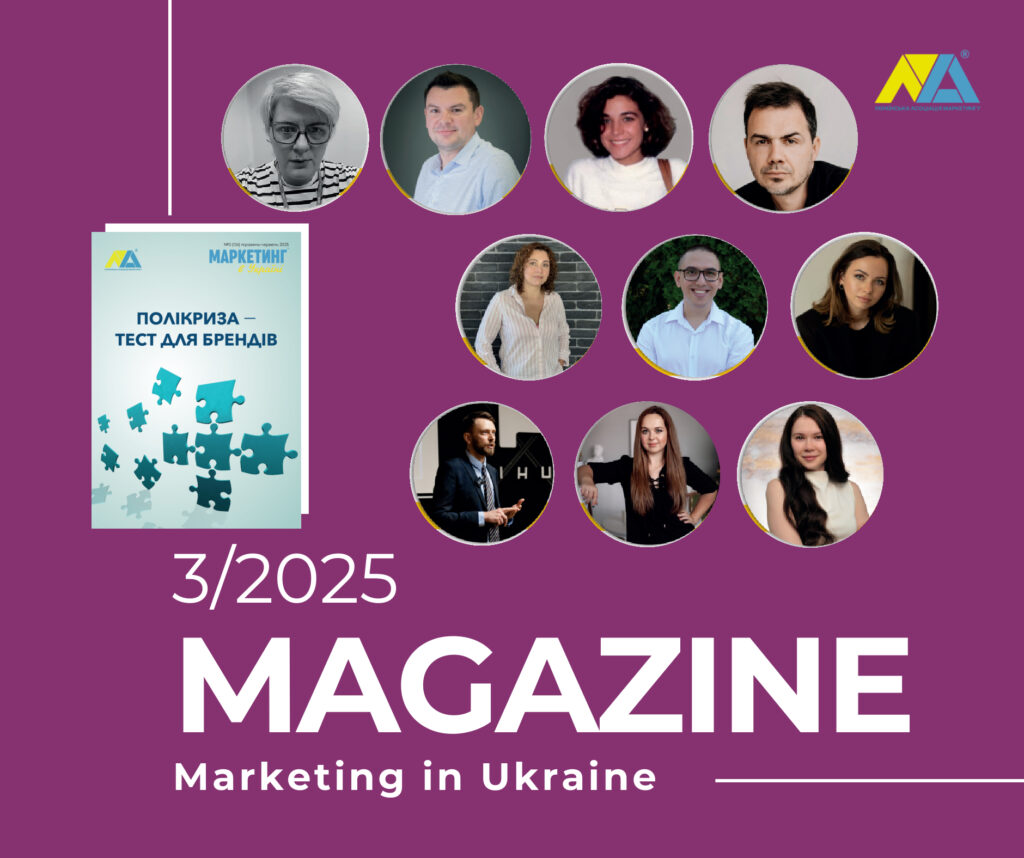

We are pleased to present the third issue of Marketing in Ukraine for 2025 – focused on the new marketing reality.
This edition explores how marketing is evolving when crisis is no longer a temporary disruption but a constant, and when “instability” becomes the norm of doing business.
War, economic uncertainty, migration, information noise, shifting values – all of this forces brands to rethink their roles, and marketers to rethink their strategies.
Here’s what you’ll find in this issue:
Iryna Baleva, Managing Director of Ipsos Ukraine – Marketing in Times of Polycrisis: How Ukrainian Brands Can Earn Consumer Trust
In a world where multiple crises don’t replace one another but instead layer and intensify, trust becomes the most scarce resource. For Ukraine, polycrisis takes on a uniquely multidimensional character. According to Ipsos research, we are living in an era where political instability, climate change, economic shocks, and armed conflicts are creating an unprecedented level of uncertainty.
Why should brands take the lead in driving change today?
Ipsos data shows that 77% of people hold a positive view of brands – 27 percentage points higher than their trust in politicians and the media. This trust gap presents a historic opportunity for companies to become more than just providers of goods or services – to become thought leaders and agents of positive change.
This article offers a detailed look at global consumer behavior trends during the polycrisis era, strategies for earning trust, technologies and innovations under crisis conditions, as well as ways to measure success and define KPIs for crisis marketing. All insights are supported by global and Ukrainian examples, practical recommendations, forecasts, and actionable steps for Ukrainian brands.
Denys Tsymbaliuk, COO of Media Systems – Ukraine’s Media Market in 2024: Stabilization, Adaptation, Growth
The year 2024 has become one of cautious optimism for the Ukrainian media market. After a sharp decline in 2022 and a phase of active recovery in 2023, the industry entered a period of stabilization. According to the Ukrainian Advertising Coalition, the volume of the media advertising market in 2024 reached approximately 90% of its pre-war level in terms of the national currency. During this time, market players gradually shifted away from crisis-response mode and began returning to strategic planning. Flexible media planning, new creative approaches, and the growing role of technology became the key drivers of recovery.
The year 2024 also marked the formation of a new paradigm for brand–media interaction. It is no longer just about reach metrics; depth of engagement is now in focus–contact time, emotional involvement, and reactions on social media all play a crucial role. The most successful brands are not necessarily those with the largest budgets, but those who bring intelligence, creativity, and adaptability to a rapidly evolving market.
This article explores the specific dynamics of the Ukrainian media market as observed by Media Systems over years of cooperation with industry players. It offers insights into current trends, key observations, and a critical assessment of the market situation.
Yeva Berezhna, Senior Researcher at NOBR.agency, and Oleh Nobr, CEO of NOBR.agency – Educational Labyrinths: How We Searched for a Compass for the National Aviation University
The National Aviation University (NAU), like many other Ukrainian universities, is facing a deep crisis of applicant engagement. The situation is further complicated by the outflow of a significant number of potential students who are seeking education and employment opportunities abroad. At the same time, young people are increasingly choosing fast-track online courses that promise immediate employment over traditional higher education. In such conditions, it is becoming increasingly difficult for universities to communicate their value.
The NOBR.agency team conducted research to understand why applicants choose one university over another and what they actually expect. The goal was to help NAU shape a relevant value proposition for prospective students. The article presents a detailed case description, including the methodology, research stages, and key insights that could be useful not only for NAU but also for the entire education sector.
Irina Maksymiuk, Head of Marketing Research Department at 4Service – Concept Test: How to Validate an Idea Before Launch. Theory, Practice, and Real Data
To avoid wasting budgets on failed products, brands test ideas even before development. One of the most effective methods is the concept test. This research (mostly quantitative) helps understand how the potential audience perceives the idea of a new product, service, packaging, or business direction. Concept testing is not an expense but an investment in success. It is a way to see the market’s reaction before launch, adjust weak points, and save resources. It acts as a kind of “insurance” against mistakes by anticipating them.
The article covers the essence of the approach, the stages of Concept Test research, and global case studies.
Volodymyr Kutiuk, Director of Research.ua – Brand Health Tracking in the Age of AI
Brand Health Tracking, especially when using CAWI methodology and rolling surveys, is an indispensable tool for modern marketers and companies. It enables not only measuring the current state of a brand but also deeply understanding its dynamics, identifying key success drivers, and promptly adapting marketing strategies. In the context of constantly changing market realities, particularly for Ukrainian companies striving for growth and resilience in a competitive environment, investing in Brand Health Tracking is not just justified but strategically essential. This approach allows companies not only to react to current changes but also to proactively shape their brand’s future by identifying new opportunities and minimizing risks. Such a systematic approach to understanding consumers and the market supports informed strategic decision-making that can ensure strong brand health and long-term success.
The article reveals the essence of Brand Health Tracking – a systematic approach to monitoring brand status. It covers important metrics ranging from spontaneous brand awareness to loyalty, differences in approaches for brands across various categories and industries, data collection methodologies, sampling techniques, and data analysis methods.
Kateryna Shumilkina, co-owner of the IT company Kitrum and head of the Marketing and Client Relations departments, – Brand Marketing in B2B IT Companies: Research and Frameworks
In B2C, marketers appeal to emotions. In B2B, it’s more complex: decisions are influenced by multiple people, each with their own role and priorities. In this context, a B2B brand is not about visual identity or loud advertising. It’s about the perception that forms in the mind of the decision-maker when they hear your company’s name – and not just theirs, but everyone involved in the decision to sign a contract. Before going public with messages, it’s essential first to find out what truly resonates with the client and then align this internally within the team. In-depth interviews provide genuine insights into the motives and decision-making context of the target audience. Internal brand sessions help the team agree on approaches and build a shared understanding.
The article discusses why the role of the brand in 2025 has become even more critical; how to conduct in-depth interviews to understand true motives; the benefits of the Hot Air Balloon internal session for teams; and how the Jobs-to-be-Done framework works in B2B. In modern branding, it’s not enough to create an attractive identity and messaging. Their impact on business must be proven. The article offers three key tools that provide clear insights and justify investment in the brand.
Dmytro Lykholet, Marketing Director at Yarych Confectionery Factory – Experience in Promoting Ukrainian Products on Export Markets
The changes triggered by the full-scale invasion are pushing manufacturers to seek new markets abroad. According to rough estimates, since the beginning of the full-scale invasion, the population has decreased by 18-25%, directly impacting the contraction of the consumer market. Yarych estimates that over the same period, the confectionery market has shrunk to 20% in absolute terms. Although Yarych has been exporting its products for over 10 years, the decline of the domestic market is driving the search to recover lost volumes abroad.
The article covers where to start: how to adapt an export strategy, what to focus on when assessing the market, how to study distribution channels, which consumer data matters, and how buyer expectations differ in Poland, Romania, the USA, and Israel.
Oksana Vobyachenko, CMO of the omnichannel CDP eSputnik – Contact Database in eCommerce: How Collected Data Becomes a Source of Profit
Modern eCommerce actively invests in effective communication with customers, as it is a key source of growth and stable revenue. But everything starts with data. High-quality data forms the foundation for making the right decisions, and the right decisions lead to better results and more efficient budget use. It is precisely the quality of contact data that brings to life the three main principles of eCommerce marketing: segmentation, personalization, and automation.
Research by G2 shows that 64% of customers expect a personalized approach based on their previous interactions with a brand. According to McKinsey & Company, companies that effectively use user data to improve the customer journey achieve revenue growth of 10-15%, while simultaneously reducing service costs by 15-20%.
This article examines how to efficiently collect contacts using proven methods, how to work with data so that segmentation becomes a reliable basis for personalization, and which trends currently shape the management of contact databases in the eCommerce sector.
Lyudmyla Voloshko, Founder and Head of Marketing at Lucy Match Marketing – The 4C Growth Model: How to Build the Customer Journey from Interest to Loyalty
In a multichannel environment where a brand doesn’t just speak but interacts, the AIDA model appears oversimplified. It doesn’t account for crucial aspects such as emotional engagement before purchase, the role of trust even before the first transaction, or support afterward. The need for a new model became clear to marketers working at the intersection of communication, sales, and customer experience.
That’s why the 4C model – Captivate, Connect, Convert, Cultivate – is increasingly replacing AIDA. It describes the customer journey not as a linear funnel but as a cycle of trust, where each stage influences the others. The 4C model is more than just theory; it’s a practical tool for brands seeking to build systematic communications across social media, advertising, content, and services.
This article discusses why banner blindness is forcing brands to rethink their approaches, how to build trust before purchase, what “selling without pressure” means in 2025, and includes examples of successful solutions.
Enjoy the read!
You can view all issues of Marketing in Ukraine magazine here.