

May 2 is celebrated as International Market Research Day (IMRD), an initiative supported and coordinated by ESOMAR, the global community for market, social, and opinion research professionals. This day highlights the valuable contribution of research professionals to decision-making in business, government, and the public sector.
The Ukrainian Marketing Association (UMA) proudly supports ESOMAR’s initiative and extends warm greetings to the research community on this professional occasion.
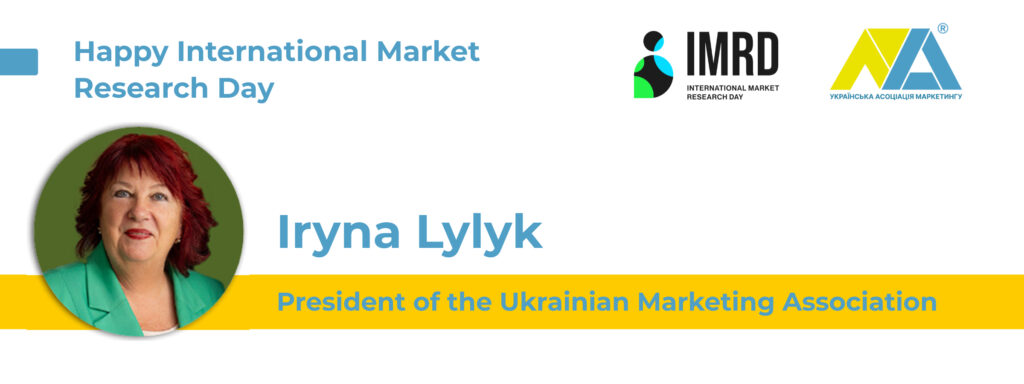
To mark IMRD, we spoke with Iryna Lylyk, President of the Ukrainian Marketing Association, about the role of research today, the challenges researchers face during wartime, and UMA’s contribution to the development of the industry.
What does International Market Research Day mean to you?
International Market Research Day is a professional holiday that aims to spotlight the work of researchers, underscore its role in decision-making, and remind researchers of their responsibility, their place in the decision-making ecosystem across various sectors, and the importance of their diligent and often challenging work.
The work of market research professionals often stays behind the scenes — and yet, no new project is born and no strategic direction is taken without them. This day is a chance to celebrate those who ask the right questions, gather answers, analyze data, and generate insights.
How did the market research industry emerge and evolve in Ukraine?
The research industry in Ukraine is represented by research agencies, in-house research professionals within companies (corporate research departments and client-side researchers), and educational institutions that develop the industry’s human capital.
The origins of the Ukrainian market research industry can be traced back to 1988, when SOCIS, the country’s first research agency, was established. Among its areas of activity were the earliest examples of marketing research. Today, the industry comprises over 200 active players, including local small and medium-sized businesses, as well as Ukrainian branches of leading international research corporations.
A significant milestone in the industry’s development came in 1997, with the founding of the Ukrainian Marketing Association (UMA). UMA developed and adopted the national “UMA Standards of Quality for Marketing Research” (SOU 91.12.0-21708654-001 2002), which clearly define the rights and responsibilities of researchers, clients, and respondents.
UMA serves as an umbrella organization for research professionals in Ukraine. Adherence to standards recognized by all members ensures high-quality research and the delivery of objective, trustworthy results.
Today, many businesses in Ukraine have established internal research departments tasked with collecting and analyzing data on markets, products, and advertising activities. Their work helps identify opportunities for existing offerings, discover new market niches, define target audiences, and guide the development of new products, services, or features. Corporate researchers also play a key role in maintaining compliance with ethical and operational standards within the research industry.
Since the late 1990s, Ukrainian universities have begun training sociologists and marketing professionals, many of whom now form the core of the country’s professional research community. More than 80 marketing departments at Ukrainian higher education institutions are currently members of the Ukrainian Marketing Association.
It is also important to highlight that the first official professional standard in the field of marketing in Ukraine was developed for the research profession. The professional standard titled “Market Research Analyst” was approved by the Ministry of Economy of Ukraine (Order No. 751-21 dated October 18, 2021). The working group that developed the standard was led by Professor Mykhailo Oklander.
Today, Ukraine’s market research industry operates on the principles of self-regulation. This means that the professional community itself develops codes and standards that its members follow to ensure research quality and maintain client trust.
What is the role of the Ukrainian Marketing Association in developing the market research industry?
Since its foundation, the Ukrainian Marketing Association (UMA) has served as a self-regulatory organization. What does that mean?
UMA’s mission is to promote market research, educate clients about the value and benefits of research, and build trust in research results as well as in the industry as a whole.
One of the key roles UMA has played in shaping the research industry is adapting international best practices to the work of Ukrainian researchers.
A primary example is UMA’s collaboration with ESOMAR, the world’s most influential professional association for market and social researchers, established in 1947 as the European Society for Opinion and Marketing Research. Today, ESOMAR unites over 4,400 members across more than 100 countries, including both researchers and research clients.
Among ESOMAR’s key responsibilities is the ongoing revision of its Guidelines and Directives, including the ICC/ESOMAR International Code on Market, Opinion and Social Research and Data Analytics. This Code serves as a global “quality umbrella” for researchers and clients alike and ensures the proper execution of international research projects, as it has been adopted by over 100 associations worldwide as a binding research standard.
In 2002, UMA introduced ESOMAR’s Code and Directives to the wider Ukrainian research and business community for the first time. With the support of UMA members, these documents were translated into Ukrainian, making them more accessible and allowing both clients and researchers to align their work with international standards. Since then, the Code has become a mandatory standard for all UMA members. The documents continue to be updated and adapted to modern needs, and UMA remains committed to informing the Ukrainian market about global trends in research. I personally led this work for 11 years while serving as ESOMAR’s National Representative in Ukraine — and the work continues to this day.
For UMA members, compliance with the UMA Quality Standards for Marketing Research (SOU 91.12.0-21708654-001-2002) is mandatory. These standards elaborate on the principles of the ESOMAR Code, offering detailed guidance on how to conduct marketing research in Ukraine. This does not contradict ESOMAR’s policies — on the contrary, one of ESOMAR’s key goals is to cooperate with national associations.
The Ukrainian Marketing Association also publishes a professional journal — “Marketing in Ukraine” — which has been in circulation since 1998. The journal covers all key industry documents, publishes in-depth analytical articles, annual market research industry overviews with forecasts and expert commentary, and features articles written by leading professionals in marketing and social research.
What challenges do researchers face in times of war?
Naturally, the research market has been significantly affected by the war and later by russia’s full-scale invasion of Ukraine. Like our colleagues around the world, we are working under new pressures — artificial intelligence, data reliability, trust in research, identifying relevant respondents, and more. At the same time, a distinctly Ukrainian context is taking shape — the war imposes restrictions and creates unique circumstances.
After major downturns in 2014 and again in 2022, the research market is now recovering. The number of research requests is growing. However, research is being conducted within the new wartime realities, which requires professional reflection and response to new challenges.
- Working with respondents who have experienced deep psychological trauma. These may include families where one parent was killed or maimed at the front, war veterans with disabilities, people who lost their homes due to shelling, or those displaced from occupied territories. Researchers must be aware of the personal trauma and the risk of PTSD (Post-Traumatic Stress Disorder) among respondents.
- Emergence of sensitive topics. Themes related to the war, uncertainty, and the future are emotionally heavy and require careful handling.
- Trust in the results of quantitative and public opinion research. Forming representative samples is a challenge, especially given widespread displacement — both internal and international — of the Ukrainian population.
- Safety concerns in conducting research. Air raid alerts and power outages significantly affect both online and offline research processes.
Advice from Ukrainian researchers – members of UMA:
- Today, more than ever, it is crucial that psychologists with expertise in PTSD and trauma lead qualitative studies. They understand individual responses and how trauma affects perception.
- We now recommend informing respondents in advance about the topic of the research and key questions to be discussed. This was not common practice before, but it is now an essential requirement for conducting ethical qualitative research.
- Analysts are adapting methodologies to ensure data validity under these conditions. The journal “Marketing in Ukraine” regularly features expert perspectives from leading Ukrainian researchers on these issues — stay tuned for new publications.
- Offline studies can only be conducted in locations equipped with bomb shelters.
- If a focus group discussion is interrupted by an air raid alert, it is effectively rendered void, and must be restarted with a different group of respondents. This contingency must be planned for in advance.
What are the expectations and forecasts for the development of the industry in 2025?
Today, when discussing the marketing research industry, we cannot overlook the impact of digital technologies on research practices. Mail surveys, field interviewer teams collecting data door-to-door — all of these are becoming things of the past. Increasingly, we are seeing the rise of CATI and online surveys, online focus groups, in-depth interviews using digital tools, user experience (UX) research, and more. The use of AI in marketing research is also advancing.
These shifts require even greater efforts from professional associations to develop clear rules and guidelines that protect respondent confidentiality and privacy, define the rights and responsibilities of both clients and researchers, and build a foundation for dialogue between them. Such dialogue is essential for achieving transparent mutual understanding of expectations.

On 7 May 2025, ESOMAR will host an event showcasing the work of national associations from around the world.
The online meeting will start at 9:00 AM Central European Time.
Participation is free of charge.
Register for the event here: https://event.on24.com/wcc/r/4940835/F51BFD2DE8F73C5EF7A187E2ADE52D4C?partnerref=website
Useful links:
- Issue No. 4-5/2024 of the journal “Marketing in Ukraine“, dedicated to the marketing research industry
- Quality Standards for Marketing Research and regulatory documents – available on the UAM website in the Standards section
- Research agencies – [link here]
- Departments that train specialists in marketing and marketing research – [link here]
- Qualitative Research in Marketing: Methods and Application Specifics – Notes from the webinar
- UX Research in Action – Invitation to the workshop on 14.05.25