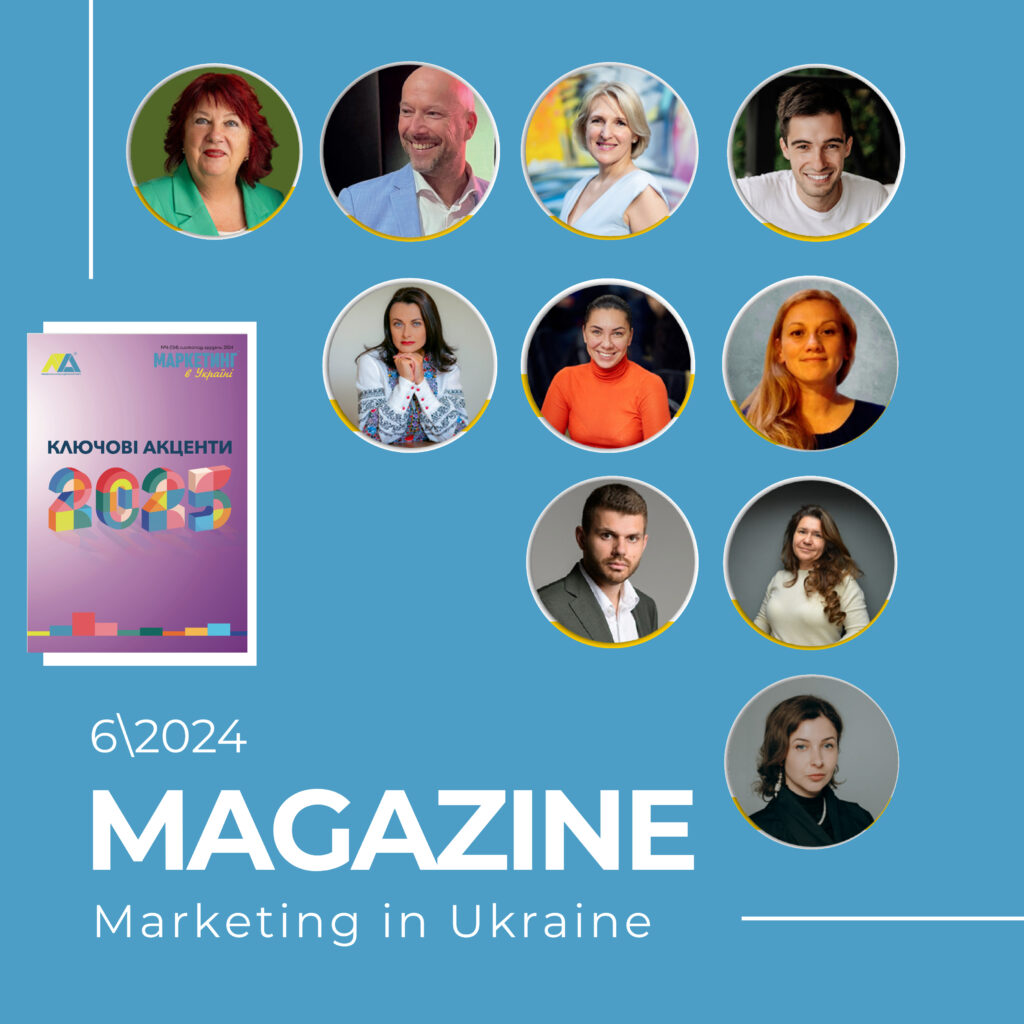

The end of 2024: where is marketing moving in 2025? These are the questions that are the focus of issue #6/2024 of Marketing in Ukraine journal. The issue will be interesting for everyone who wants to understand trends of upcoming 2025.
In this issue:
Iryna Lylyk, President of Ukrainian Marketing Association and Editor-in-Chief of Marketing in Ukraine journal, believes that we have entered marketing era “between challenges and responsibilities”. Modern marketing responds to global and local challenges, adapts to new ethical standards, strengthens its social role and changes approaches to communications under the influence of war. Global trends are also reflected in Ukraine, but with rethinking and adaptation to realities. This changes the entire concept of communication of professional associations and the content of their work. And it’s not just about technology, although it’s also important, but about focusing on responsibility and developing rules, understanding the importance of each member of a professional association and the impact of their activities.
Brand management, Marketing Operations, Digital Transformation and MarketingTech are the most important areas that marketing executives advise to focus on and prioritize, according to the results of the European Marketing Agenda 2024 survey. In his article, Martin Huisman, COO of the European Marketing Confederation, reveals the essence of each of these areas, as well as analyzes the challenges, trends and insights that accompany them.
The new reality is working in “beta mode,” where learning by doing is becoming norm. Marketers now face the challenge of determining which trends, like the metaverse and Web3, will have real business value and which may soon disappear. In contrast, AI has already made a significant impact on the industry. The shift from theoretical discussions on data to practical applications—like ChatGPT—demonstrates how AI can provide clear business benefits and is expected to influence customer experience strategies substantially.
Kantar Ukraine team has made conclusions about the relevance of global marketing trends for the Ukrainian market and prepared an article based on the analytical conclusion of Kantar specialists who analyzed the results of numerous company studies over the year and identified the key marketing trends in the world for 2025 – Kantar Marketing Trends 2025 report. The authors describe in detail 10 main global marketing trends and their reflection in Ukraine.
Global marketing trends of 2025 are active use of AI, growing interest in sustainable development, influence of creators on brand image and sales, growing importance of inclusiveness, innovative approaches to market expansion, development of retail media networks, the growing popularity of streaming services among young people, live stream shopping and fatigue from social media advertising, slowing population growth due to the birth crisis and population loss due to the war are also observed in Ukraine.However, situation in Ukraine differs from what is happening in the world. After all, war and difficult political and economic situation affect the direction of these trends or their speed of implementation. War and economic difficulties can limit investment in marketing, but at the same time stimulate innovation and adaptation to new conditions. Therefore, companies should be flexible and ready to change in order to effectively respond to challenges and use opportunities of the current time.
Info Sapiens has been conducting the Consumer Confidence in Ukraine survey since 2019, tracking changes in Ukrainians’ perceptions of their current situation, economic expectations, and general consumer sentiment. Every month, the company surveys representative sample of the Ukrainian population to assess their financial situation, economic perspectives, and willingness to spend money on large purchases. The results demonstrated dramatically different dynamics of the index, which almost always reflected major events for our country: occupation of Crimea and parts of Donetsk and Luhansk regions in 2014, subsequent gradual economic recovery with a peak in 2019, Covid-19 pandemic in 2020 and the full-scale invasion in 2022.
Edem Galimov, Head of Marketing Research at Info Sapiens, in his article on the use of consumer sentiment research for business development, focused on what has been happening with the consumer sentiment index over the past few years with a focus on 2024, analyzed how to adapt and adjust the marketing strategy depending on the results of consumer sentiment research, as well as how to adapt tactical and strategic steps based on data and considered what expectations we have for 2025.
Kateryna Shuta, Head of Communications at YouControl, talks about communications in the era of change: 2024 results and PR trends for 2025. In a world where disinformation is spreading faster than ever, society demands authentic and transparent communications, and companies need stable reputation management. Anti-crisis communications, careful corporate image management, and increased public engagement have become not only desirable but vital for organizations. The role of PR is not only growing, but is also undergoing a transformation at the strategic level: the tasks of PR professionals are increasingly integrated with business goals – from increasing profits and entering international markets to building long-term partnerships and stable customer relationships. The impact on the company’s progress and sustainable development is pushing PR efforts to be even more clearly measured, analyzed, and directly linked to the successes and failures of the organization or project.
In an era when the flow of information exceeds the capacity of human attention, video content is becoming the main communication tool. Millions of visuals are created every second in the world – from short TikTok videos to large-scale video campaigns of global brands. But why did video become the king of content? How does it influence our thinking, decisions, and even culture? Iryna Boberets, a commercial video director and mobile filming trainer, tries to figure it out in her article.
Brands that rely on video content get a unique opportunity to get closer to their customers. And most importantly, they remain in the memory. So if your strategy doesn’t yet include video, it might be time to rethink your approach. After all, the future has already arrived, and it’s in the frame.
Technocratic trend is driving all processes in the digital world, and the marketing industry is no exception. Tech giants such as Google and Meta are constantly looking for ways to make their advertising platforms as automated as possible and with minimal human intervention. One of these products is Google’s Performance Max, a type of advertising. PMax utilizes machine learning capabilities to deliver better performance and get more conversions across all channels and across Google’s entire ad inventory. Inna Pashniak, Head of Digital Marketing at Publicis Health Media, explains in her article what Performance Max is, the characteristics that differ this type of online advertising from others, and its main trends in 2025. The article also discusses the main advantages of PMax, which include advertising on all Google platforms, automation of campaign management and improved reporting.
In conditions of the enormous information noise in the modern marketing world, visual content makes all the difference: emotions are the key factor that makes consumers stop, react, and make a purchase. This is especially true in the face of growing competition. In his article “Photography as an Emotional Tool: Visual Content Trends 2025,” Oleksandr Radomskyi, founder of a school for photographers, author and teacher of a unique technique of video shooting in motion, made a historical overview of how photography has changed marketing and why dynamic photography is in trend today, showed visual content trends that should be adapted today and provided tips on how to prepare for the visual future.
Brand protection, or what a marketer should know. How to protect your brand? What strategies are used in Europe to support small and medium-sized businesses? Why does the Ukrainian approach to intellectual property no longer work? Olena Yakobchuk, an international patent strategist, patent attorney certified in all IP objects, author of patent algorithms for solving problems of the pharmaceutical industry, in her article analyzes European brand protection strategies; talks about key intellectual property tools (trademark, design and copyright) and their management; gives practical recommendations for Ukrainian marketers on how to adapt to European standards. The author emphasizes that trademark registration is only the first step. To ensure reliable brand protection, it is necessary to constantly maintain its security. Therefore, after registering a TM, you should not “sleep” – the brand needs your constant attention.
Niya Nikel, head of NGO Epiprosvita and an expert at the Ministry of Health with many years of experience in the charitable sector, draws attention to common mistakes made by NGOs in marketing and communications. In her article, the author shares practical advice and reveals three components of a solid foundation for marketing in the public sector. Many civil society organizations often lack knowledge of business processes and the ability to build partnerships with commercial entities. However, the first step towards independence from grants is to build a properly structured marketing and sales of your own brand. Nia’s algorithm will definitely be useful to the public sector and everyone who wants to make qualitative changes in the field of charity.
The current issue of Marketing in Ukraine journal – #6/2024 – is available here