

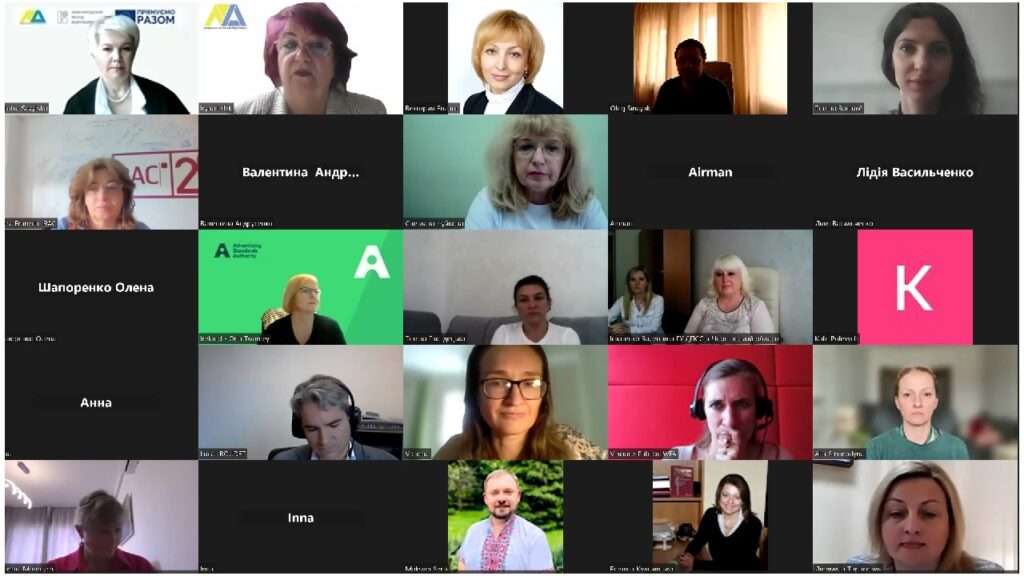
On May 30, 2024, more than 100 marketing specialists discussed the issue of protecting children’s rights from unhealthy food advertising as part of the Strategic Session “European practice of marketing regulation to protect the rights of children and adolescents from the influence of unhealthy food advertising.” The quality of food directly affects people’s health, and advertising forms the demand for products.
The Strategic Session was attended by European and Ukrainian experts in the field of marketing and advertising, representatives of the food industry and state regulators.
Iryna Lilyk, president of the NGO “Ukrainian Marketing Association”, noted that the recent amendments to the Law of Ukraine “On Advertising” created the conditions for joint regulation by business and the state of the issue of advertising extra processed food products with a high content of sugar, salt and trans fats. The time has come when it is necessary to decide which way of regulation of this market will be chosen – strict regulation, self-regulation or joint regulation. Ukraine’s choice!
Lucas Boudet Director General, Tudor Manda, Self-Regulation Development Manager, European Alliance for Standards in Advertising (EASA) emphasized that only effective interaction of the food industry, regulatory authorities, advertising agencies and the scientific community can create conditions to protect children’s rights from the influence of advertising unhealthy food.
“We jointly develop Rules, Recommendations, Codes, conduct trainings to prevent the appearance of misleading advertising. We also handle consumer complaints and monitor advertising. We welcome Ukraine’s initiative to implement European self-regulation standards to protect children’s rights from unhealthy food advertising.”
Presenting the results of the “EU Pledge” project, the aim of which was to introduce responsible self-regulation of the marketing of food products with high fat and sugar content, representatives of the World Federation of Advertisers – Vinciane Patelou, Director of Consumer Policy WFA and Ana-Elena, senior program manager EU Pledge, – emphasized that most countries of the world regulate the issue of advertising food products to children. Regulatory acts are developed both at the EU level and at the national level.
“The EU Pledge (EU Plege) is a voluntary commitment made by major food and drink manufacturers to responsibly advertise to children under 13 years of age. Global brands and local companies joined the initiative. In general, the participants of the initiative cover up to 80% of advertising in Europe.”
Orla Twomey, Chair of the European Advertising Standards Alliance and representative of the Advertising Standards Authority in Ireland, shared Ireland’s experience of implementing joint regulation in the field of protecting children’s rights from unhealthy food advertising. She emphasized that the dialogue with the industry was not easy, but the arguments of doctors and disease statistics provided by the Irish regulatory body in the field of health care formed opportunities to reach representatives of the food industry, who, subsequently, developed and accepted restrictions in the field of advertising children and teenagers products with a high content of fat, salt and sugar.
Laura Frunzeti, Executive Director of the Advertising Standards Authority of Romania, provided examples of the application of the Romanian Code of Ethics for Advertising to Children, which was adopted in 2008. The main principles concern the protection of children’s rights from unhealthy food or excessive consumption. To this end, restrictions on the display of portion sizes in advertising have been implemented. Children should not come into contact with the food, should not make certain comments, such as “it’s very tasty”, “the taste is excellent”, “I really like it”, because in this way advertisers can push parents to buy such products for their children. Advertisements are prohibited from showing products that contain more calories than recommended for a balanced diet for children under 15 years of age.
Yuliya Shkurko, head of the analytical department of the Pro-Consulting company, presented the trends in the baby food market in Ukraine. The children’s products market offers consumers a wide range of fermented milk products (yogurts, sweet and glazed cheeses and desserts), fruit and berry purees and juices, drinking water and sweet drinks, healthy breakfasts, treats and even sauces and mayonnaise. Considering the demographic situation in the country, manufacturers of children’s products work within a fairly high level of competition for consumers. This prompts them both to create a unique sales offer and to active marketing activities to promote products.
Alla Smorodyna, lawyer of Sayenko Kharenko JSC, expert in intellectual property law, doctor of philosophy, commented on the Law of Ukraine “On Advertising”, which is fundamental for the advertising industry: “The law contains reasonable and correct principles that should be applied to any advertising , which is aimed at or involving children. These provisions are based on world practice. The Law of Ukraine “On Advertising” does not currently contain special provisions with requirements or prohibitions regarding the advertising of “unhealthy food”. The approach outlined for the advertising of alcoholic beverages and tobacco products can be useful, as an example of banning the sale of a certain category of goods and their advertising. Regarding the prospects of legal regulation of restrictions and prohibitions of advertising “unhealthy food” at the level of self-regulation of industries, it is worth determining that this is also a global practice. Ukraine still has to go this way.”
The event was held within the framework of the project “Harmonization of the Ukrainian policy of implementing the regulation of food marketing with the European practice of protecting the rights of children and adolescents from the influence of unhealthy food advertising”, which is implemented by the NGO “Ukrainian Marketing Association” in partnership with EASA, the NGO “Nutrition and Quality of Life” and DPSS of Ukraine. The urgency of the project is due to the need to harmonize with the Ukrainian market the developed European practices of applying regulatory and voluntary restrictions on the marketing of unhealthy food among children and adolescents with the aim of Ukraine’s entry into the EU single market. Based on the results of the project, recommendations will be provided regarding the adaptation of the National Program of Approximation of the Legislation of Ukraine to the acts of EU law.
The project is supported by the European Union and the International Renaissance Foundation, within the framework of the joint initiative “European Renaissance of Ukraine”.
For more detailed information, please contact the address
umaukras@gmail.com